Page 42 [42]

OCR
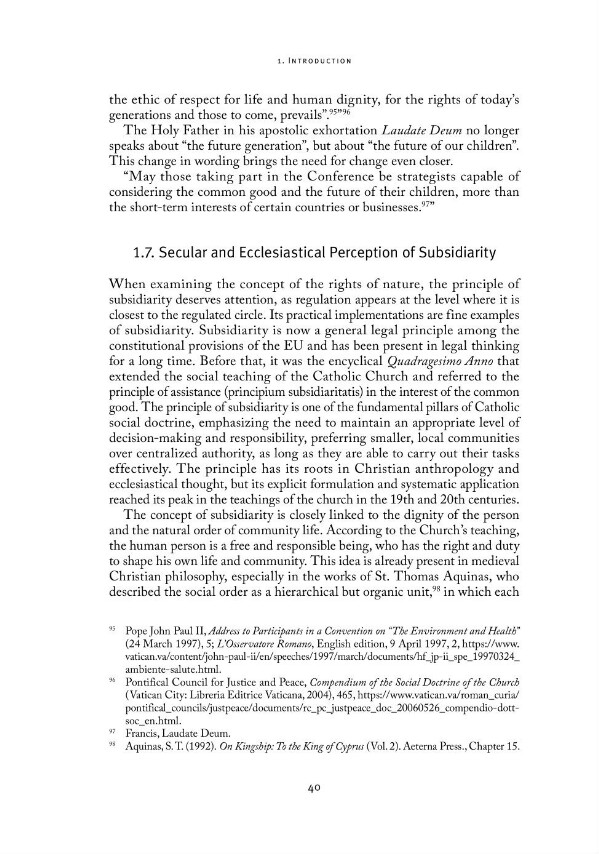
1. INTRODUCTION the ethic of respect for life and human dignity, for the rights of today’s generations and those to come, prevails”.°””* The Holy Father in his apostolic exhortation Laudate Deum no longer speaks about “the future generation”, but about “the future of our children”. This change in wording brings the need for change even closer. “May those taking part in the Conference be strategists capable of considering the common good and the future of their children, more than the short-term interests of certain countries or businesses.??” 1.7. Secular and Ecclesiastical Perception of Subsidiarity When examining the concept of the rights of nature, the principle of subsidiarity deserves attention, as regulation appears at the level where it is closest to the regulated circle. Its practical implementations are fine examples of subsidiarity. Subsidiarity is now a general legal principle among the constitutional provisions of the EU and has been present in legal thinking for a long time. Before that, it was the encyclical Quadragesimo Anno that extended the social teaching of the Catholic Church and referred to the principle of assistance (principium subsidiaritatis) in the interest of the common good. The principle of subsidiarity is one of the fundamental pillars of Catholic social doctrine, emphasizing the need to maintain an appropriate level of decision-making and responsibility, preferring smaller, local communities over centralized authority, as long as they are able to carry out their tasks effectively. The principle has its roots in Christian anthropology and ecclesiastical thought, but its explicit formulation and systematic application reached its peak in the teachings of the church in the 19th and 20th centuries. The concept of subsidiarity is closely linked to the dignity of the person and the natural order of community life. According to the Church’s teaching, the human person is a free and responsible being, who has the right and duty to shape his own life and community. This idea is already present in medieval Christian philosophy, especially in the works of St. Thomas Aquinas, who described the social order as a hierarchical but organic unit,”* in which each % Pope John Paul IT, Address to Participants in a Convention on “The Environment and Health” (24 March 1997), 5, L’Osservatore Romano, English edition, 9 April 1997, 2, https://www. vatican.va/content/john-paul-ii/en/speeches/1997/march/documents/hf_jp-ii_spe_19970324_ ambiente-salute.html. % Pontifical Council for Justice and Peace, Compendium of the Social Doctrine of the Church (Vatican City: Libreria Editrice Vaticana, 2004), 465, https://www.vatican.va/roman_curia/ pontifical_councils/justpeace/documents/rc_pc_justpeace_doc_20060526_compendio-dottsoc_en.html. Francis, Laudate Deum. Aquinas, S. T. (1992). On Kingship: To the King of Cyprus (Vol.2). Aeterna Press., Chapter 15. 97 40
